Thứ Tư, 18 tháng 3, 2026

JÜRGEN HABERMAS: NGƯỜI DÂN PHẢI LÀ “ĐỒNG TÁC GIẢ” CỦA LUẬT PHÁP


Nguyễn Minh Tuấn

Tạp chí Tia sáng, đăng ngày 18/3/2026, 

truy cập tại địa chỉ: 

 https://tiasang.com.vn/j-rgen-habermas-nguoi-dan-phai-la-dong-tac-gia-cua-luat-phap-5051344.html

Jürgen Habermas, nhà tư tưởng lớn của Đức, một trong những người có ảnh hưởng mạnh nhất đến tư tưởng pháp luật, dân chủ và tính chính đáng của quyền lực nhà nước, vừa qua đời ngày 14/3/2026 ở tuổi 96.

Sự ra đi của ông không chỉ khép lại cuộc đời của một học giả lớn, mà còn khiến giới học thuật nhìn lại sâu sắc hơn di sản tư tưởng mà ông để lại cho đời sống chính trị - pháp lý hiện đại.

Thứ Năm, 12 tháng 3, 2026

LỊCH SỬ PHÁP LUẬT THẾ GIỚI


Tên sách: Lịch sử pháp luật thế giới
Tác giả: PGS.TS. Nguyễn Minh Tuấn; ThS. Trần Tuấn Kiệt
Khổ: 16×24 cm
Độ dày: 1,3 cm
Khối lượng: 600g – 700g
Số trang: 488 trang
Nhà xuất bản Hồng Đức
Liên kết xuất bản Công ty cổ phần Xuất bản và Giáo dục Quảng Văn
Thời gian phát hành: tháng 5 năm 2026

Cuốn sách này được biên soạn như một hành trình kể chuyện sống động về sự hình thành và phát triển của pháp luật qua hàng ngàn năm, từ những bộ quy tắc sơ khai thời cổ đại đến các hệ thống pháp lý phức tạp ngày nay. Sách được thiết kế không chỉ dành riêng cho sinh viên chuyên ngành luật, giảng viên, các chuyên gia pháp lý (luật sư, thẩm phán, công chứng viên) mà còn phù hợp với bất kỳ độc giả nào mong muốn tìm hiểu về trật tự xã hội và lịch sử văn minh nhân loại một cách sâu sắc. Tuy nhiên, cuốn sách này không dừng lại ở việc liệt kê các sự kiện khô khan mà hướng tới việc giải mã “tại sao” và “như thế nào” pháp luật lại định hình cuộc sống con người. Khi đã thấu hiểu được gốc rễ lịch sử của các quy định pháp luật, độc giả có thể thoát khỏi tư duy áp dụng luật một cách máy móc để cảm nhận được giá trị thực sự trong từng điều khoản. Ngoài ra, việc nắm bắt được bức tranh toàn cảnh về sự đấu tranh cho công lý, bình đẳng và nhân quyền trong quá khứ sẽ là nền tảng quan trọng giúp người học luật hiện đại hình thành bản lĩnh nghề nghiệp và tư duy phản biện sắc bén. Bên cạnh đó, việc hiểu rõ bối cảnh ra đời của các bộ luật cũng giúp chúng ta trân trọng hơn những quyền con người hiện hành và có cái nhìn thấu đáo hơn trước các xung đột pháp lý đương đại.  

Ở cấp độ của các cơ sở đào tạo luật học và nghiên cứu xã hội, cuốn sách này có thể sử dụng làm tài liệu tham khảo chủ đạo hoặc bổ trợ cho các môn học về Lịch sử nhà nước và pháp luật hay Lý luận chung về pháp luật. Với tinh thần kết nối giữa quá khứ và hiện tại, tác giả không chỉ cung cấp kiến thức sử học mà còn gợi mở những suy ngẫm về vai trò của con người trong việc kiến tạo công lý. Ngoài ra, để đáp ứng nhu cầu đổi mới phương pháp giảng dạy luật từ “học thuộc” sang “thấu hiểu”, cuốn sách cũng đóng vai trò như một chất xúc tác để giảng viên và sinh viên cùng thảo luận, từ đó khơi dậy niềm cảm hứng và sự tò mò, hướng tới mục tiêu đào tạo nên những người hành nghề luật không chỉ giỏi chuyên môn mà còn giàu tri thức xã hội và lòng trắc ẩn. 

Kéo xuống để xem mục lục, lời giới thiệu. Link đặt sách, click tại đây

GOVERNANCE OF CONSUMERS' PERSONAL DATA IN E-COMMERCE IN VIETNAM

Abstract:

This article examines the governance of consumers' personal data in Vietnam's e-commerce sector. It argues that the rapid expansion of the country's digital economy has intensified the collection, processing, and circulation of personal data across online platforms, thereby increasing risks of misuse, unauthorized disclosure, and inadequately controlled cross-border transfers. Based on doctrinal analysis of Vietnamese law and comparative engagement with the European Union's General Data Protection Regulation, the article shows that Vietnam is moving from a fragmented privacy-protection approach toward a more structured model of data governance. Nevertheless, important weaknesses remain, including regulatory inconsistency, limited enforcement capacity, fragmented supervisory arrangements, and insufficiently effective mechanisms for the exercise of data-subject rights. The article concludes by proposing legislative and institutional reforms designed to strengthen platform accountability, improve the coherence of sanctioning mechanisms, and enhance consumer trust in the digital marketplace. 

Keywords: 

Consumer Protection, Data Governance, E-Commerce, Personal Data, Vietnam 

RETHINKING VIETNAM'S LEGAL SYSTEM FOR A NEW DEVELOPMENT ERA


Nguyen, M. T. (2026). 

Rethinking Vietnam’s legal system for a new development era.  

Multidisciplinary Science Journal (Scopus/WoS)

Retrieved from here 

Abstract

Vietnam's legal architecture is still marked by conceptual ambiguity, doctrinal fragmentation, and a strong administrative legacy that limits coherence, predictability, and adaptive capacity. This article re-examines Vietnam's legal system in light of current reform demands, especially the implementation of Resolution No. 66-NQ/TW and the broader transition toward a development-oriented and rule-of-law-based state. The study pursues three objectives: first, to synthesize major contemporary theories of the legal system; second, to assess their analytical value for Vietnam's institutional context; and third, to formulate feasible reform directions for the next stage of legal development. Methodologically, the article adopts a qualitative design that combines doctrinal analysis, structured document review, and functional comparison. The corpus includes foundational legal theory, selected Vietnamese scholarship, constitutional and legislative texts, and comparative materials from Germany, the United Kingdom, Singapore, and Malaysia published or in force between 1994 and 2025. The analysis shows that Vietnam's current legal order is weakened by three interrelated problems: an underdeveloped theoretical foundation, a rigid branch-based organization that produces procedural overlap, and an overly statute-centered understanding of legal sources. In response, the article proposes five mutually reinforcing reform directions: consolidating a composite doctrinal framework centered on the rule of law, developmental law, rights-based law, risk regulation, and legal minimalism; replacing compartmentalized procedures with integrated regulatory pathways; broadening legal sources beyond statutes; strengthening compatibility review for international commitments; and transforming the electronic code into an interoperable governance platform. It further argues that these reforms will face bureaucratic resistance unless accompanied by sequencing, accountability mechanisms, judicial safeguards, and digital implementation capacity. By linking legal theory to institutional design, the article offers a more operational framework for restructuring Vietnam's legal system in the new development era.

Keywords: rule of lawplural sourceregulatory minimalise-governancecomparative jurisprudence 

Thứ Tư, 11 tháng 3, 2026

FROM CLINICS TO DIGITAL PLATFORMS: REDEFINING LEGAL LIABILITY IN VIETNAM'S EMERGING HEALTHCARE SYSTEM

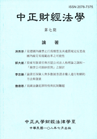
https://www.angle.com.tw/Publish/Control/pictures/Magazine/magazine-68.gif 

NGUYEN Minh Tuan

Chung Cheng Financial And Economic Law Review

No. 31 July 2025, pp.307-336

DOI: 10.53106/207873752025070031006

Link: https://lawdata.com.tw/tw/detail.aspx?no=915142 

Abtract: As digital and remote healthcare expand rapidly in Vietnam, key legal questions arise: If a misdiagnosis occurs via a telemedicine platform, who is responsible—the doctor, the hospital, or the technology provider? This paper examines legal liabilities emerging from digital healthcare practices in Vietnam, including civil, administrative, and professional responsibilities. It reviews existing Vietnamese laws and identifies major gaps—especially regarding technical standards, duty of transparency, and patient safeguards. The paper proposes directions for building a legal framework that addresses these challenges while encouraging innovation in Vietnam's healthcare sector.

Keywords: Digital health; Legal liability; Telehealth; Artificial intelligence in healthcare; Legal framework in Vietnam.